Helpdesk ≠ ServiceDesk ≠ Helpdesk
Introduction – When Definitions Collapse
In IT, we drown in titles with thin definitions; new ones appear each year while the old are simply repainted. Somewhere along the way, we forgot that definitions exist for a reason. Unlike regulated professions—medicine, law, engineering—our field allows anyone to claim any title they like. There is little protection, and standards lack upholding. Certification bodies such as Cisco, Microsoft, or Axelos set frameworks for individuals; yet entire organizations operate under those titles without the faintest notion of what they imply. The result is a theatre of prestige labels worn like costumes; accountability remains an afterthought.
This is not about individuals; it is about structure, responsibility, and integrity. IT’s vocabulary used to mean something. A Helpdesk was a Helpdesk. A ServiceDesk was a defined function, not a marketing term. These distinctions emerged for good reason. In the 1980s, Helpdesks handled reactive user support; pure firefighting. The 1990s brought ITIL and the concept of Service Management; IT was no longer just about fixing but about delivering. By the 2000s, ITSM and ISO/IEC 20000 introduced governance and maturity models. Then digital transformation, outsourcing, and automation blurred those boundaries again. Now, we find ourselves back where we started; only with shinier tools and less clarity.
For context, see The Never-Ending IT Firefight, where I explored how support work degenerates under turnover, lost documentation, and vanishing accountability. This text continues that discussion; because before we can fix the system, we must call things what they truly are.
Helpdesk – Firefighting by Design
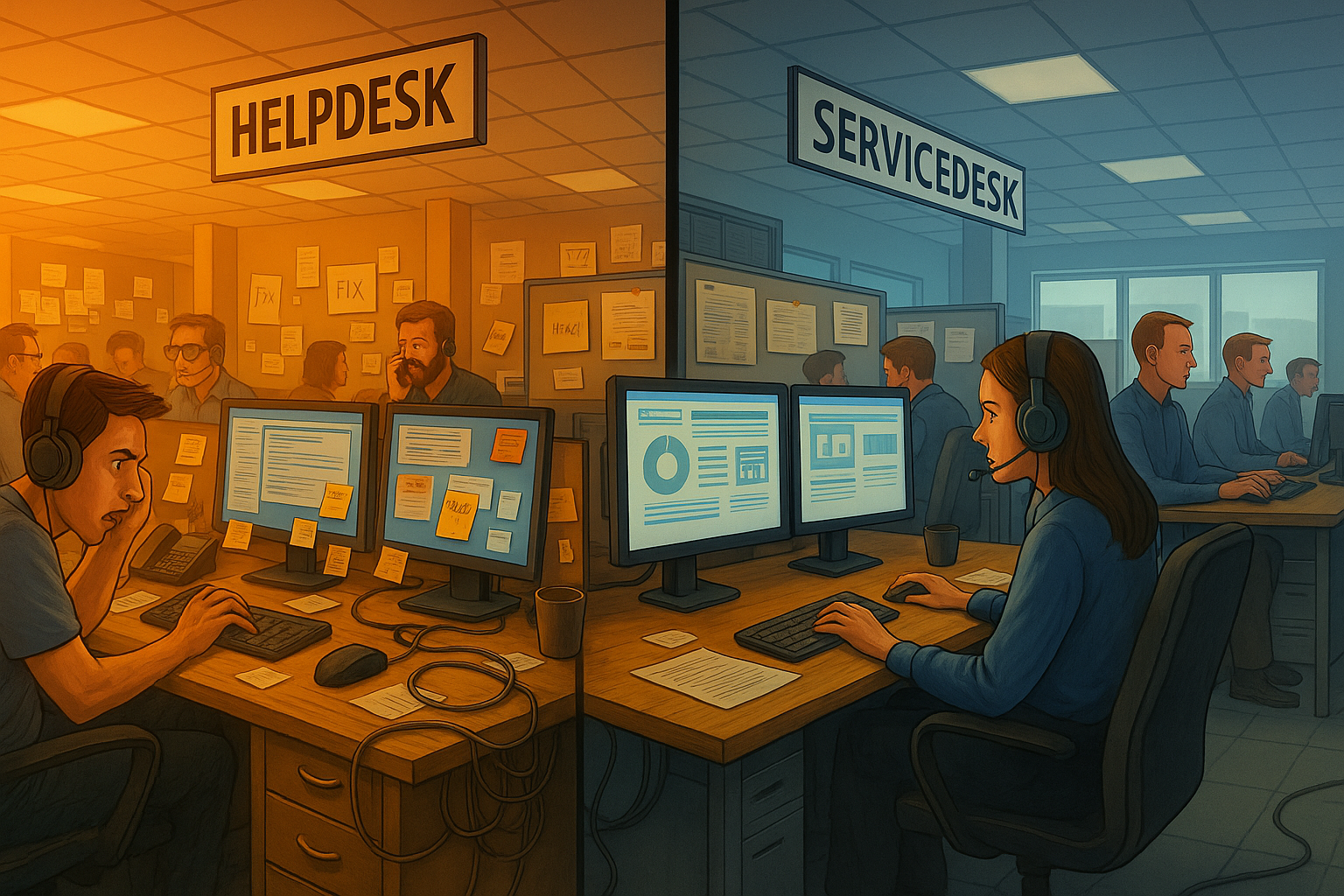
A Helpdesk is the reactive layer of IT support; the first to see the flames and the last to get proper training. It exists to restore function, not to manage quality. Its key metrics—ticket volume, closure rate, time-to-resolution—create an illusion of efficiency while rewarding only speed. The faster the fix, the better the score; never mind if the issue resurfaces next week.
The Helpdesk model, born from necessity, is transactional by design. Its strength lies in triage and basic troubleshooting; but without systemic feedback or analytical time, it becomes a treadmill. There is no reflection, no improvement; only motion. Escalations multiply, documentation stalls, and the same problems keep returning like clockwork.
This isn’t the fault of the staff; most are doing their best with little context, minimal authority, and constant pressure to close tickets. The real problem is structural. A Helpdesk built on throughput metrics cannot evolve; it becomes a containment mechanism for dysfunction rather than a bridge to resolution.
ServiceDesk – Structure, Not Cosmetics
A ServiceDesk is supposed to be something else entirely; not an improved Helpdesk, but a different function built on maturity and management. In ITIL v4, the Service Desk practice is the single point of contact for incidents and requests—a communication hub that manages not just problems but expectations [1]. It bridges operational delivery with business outcomes; tying user needs to the broader value chain [2]. A ServiceDesk is intended to serve as a single point of contact for all user service needs; not only fire-calls [3].
A proper ServiceDesk owns visibility, analysis, and improvement. It connects incident, problem, and change management; it documents, follows trends, and participates in the prevention of recurrence [4]. It is the operational conscience of IT; not its call centre.
Modern practice expands this further. Self-service portals, chatbots, and AI-driven knowledge systems automate routine requests; a mature ServiceDesk uses the data these generate to refine service patterns and guide users intelligently. The difference lies in attitude; a Helpdesk works case-by-case, a ServiceDesk manages the ecosystem.
The False Transition – Labels Without Change
This is where the frustration begins; countless organizations claim to have “evolved” from Helpdesk to ServiceDesk, yet when examined, nothing truly changed. The same daily grind persists; the same ticket floods, the same blind escalations, the same race to meet meaningless metrics. The only transformation was in terminology.
It is astonishing how often leadership equates rebranding with progress. A slide deck, a new workflow tool, and a few borrowed ITIL phrases; suddenly, there it is—a “ServiceDesk.” Never mind that no Service Management processes exist, no roles are defined, and no one understands what a Problem record even is.
This false transition happens because management wants improvement without investment; maturity without change. It is easier to rename than to reform. Vendors encourage this illusion as well; selling platforms and calling them “ITSM solutions,” when in reality they are only glorified ticket trackers. Tools cannot create maturity; structure and culture do.
The most damaging part of this charade is that it tricks everyone. Management believes progress was made; staff believe they work in a professional environment; customers believe they are covered by SLAs. Beneath the veneer, the machine still runs on chaos. The ServiceDesk name is worn proudly while none of its responsibilities are fulfilled.
Why It Happens – Budgets, Incentives, and Blind Spots
Why does this pattern repeat? Because it is cheaper to appear mature than to become mature. The cause is neither malice nor stupidity; it is economic gravity. Budgets are tight, priorities short-term, and incentives misaligned.
Organizations optimize for visible output, not lasting stability. Tickets closed per day look impressive on paper; a well-documented root cause analysis does not. Management dashboards reward volume, not learning. Improvement takes time; time costs money. The outcome is predictable: repeat incidents are tolerated, knowledge work is neglected, and the idea of continuous improvement remains a slide in a presentation.
There is also a psychological component. IT departments often believe that implementing a framework automatically makes them compliant with it; the framework becomes decoration, not discipline. Few leaders actually read what ITIL defines; fewer still apply it correctly. The result is not incompetence, but complacency; a quiet acceptance of “good enough,” reinforced by KPIs that measure the wrong thing.
The Vacuum Between – Where Problems Go to Hide
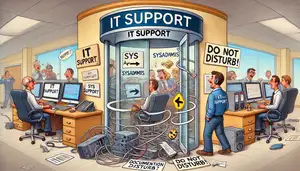
Between Helpdesk and ServiceDesk lies a vacuum; a grey zone of ownership where recurring issues, undocumented workarounds, and “temporary” fixes pile up until they become permanent. This is where problems go to hide.
Tickets circulate endlessly between first- and second-line support; knowledge is neither captured nor transferred. Users repeat the same symptoms, technicians repeat the same resolutions, and the system reports a false sense of activity. The busier it looks, the less it achieves.
Inside this vacuum, accountability evaporates. Nobody owns the underlying cause. Management receives clean reports—tickets opened, tickets closed—and assumes progress. Meanwhile, technical debt accumulates quietly in the background. Documentation becomes ritualistic; the minimum text to satisfy a closure rule. Over time, teams forget that documentation was supposed to teach; not just to tick a box.
From the inside, it feels like an endless treadmill; from the outside, it looks like productivity. In reality, it is stagnation disguised as motion.
Reform – A Modest Path Forward
Helpdesk or ServiceDesk? Reactive chaos or structured accountability? The distinction is not academic; it determines whether IT support remains a profession or collapses into industrialized scriptwork.
If words are to mean anything again, then reform must begin with integrity. Stop naming things what they are not. If you run a Helpdesk, call it that; then build from there. The transition to a ServiceDesk is not a cosmetic upgrade; it is a cultural, procedural, and managerial evolution.
Criticism without prescription is hollow; so here is the prescription.
- Map where your organization truly stands on the maturity continuum—from reactive to proactive to business-aligned—using models such as HDI’s Service Desk maturity framework [5].
- Define clear ownership boundaries. Know what the Helpdesk should solve and where the ServiceDesk begins; do not blur the two for convenience.
- Make every escalation meaningful. If you forward a ticket, attach context; data, reasoning, and possible cause. Escalation is not abdication.
- Invest in structure before software. A new tool will not compensate for a broken process.
- Document for knowledge, not compliance. Write to teach; not to prove that a checkbox was filled.
- Measure value, not volume. Count resolved causes, not closed tickets. Stability is an achievement; not an absence of work.
- And finally—hold leadership to the same standards as the staff. If management claims to deliver service, it must also embody Service Management.
A polished title will not fix broken systems; a ServiceDesk without service is only a name. But a name used honestly—with discipline, accountability, and structure—can restore meaning; and perhaps even respect; to a profession that has been too long misunderstood.
References
- Axelos, ITIL® 4 Foundation, 2019 – Defines the Service Desk as the single point of contact for users and communication hub in service management.
- itsm.tools, ITIL 4 Service Desk Practice Guide Summary, 2023 – Describes the Service Desk as a cross-value-stream practice connecting users and services.
- Atlassian, Help Desk vs Service Desk vs ITSM, 2024 – Clarifies that a Service Desk manages all user interactions; not only incidents.
- KnowledgeHut, ITIL Service Desk: Overview and Functions, 2023 – Outlines Service Desk integration with problem, change, and knowledge management.
- HDI, Transform Your Existing Help Desk into a Modern Service Desk, 2023 – Introduces the HDI Service Desk maturity continuum and improvement roadmap.
About This Article
This article continues my reflections on the structural and cultural flaws within IT support, being the most visible layer of any IT organisation. It is written from experience, but not aimed at any one organisation or individual. The tone may sound frustrated—because it is—but the intent is constructive: to remind readers that words like “Service” and “Management” carry obligations, not just aesthetics. If the piece provokes a moment of recognition or discomfort, then it has done its job; progress begins when terminology meets integrity.