30 Years in IT, 60 in Life — and Still Running Patches
Repost from LinkedIn
This spring, I hit two milestones: 60 years of life, and 30 years in IT.
One says I'm getting old. The other says I'm just getting better at fixing things people shouldn't have broken in the first place.
This isn't a CV. It's a glimpse at what I've learned, built, broken, and survived — from retail stockrooms to server racks, from modding forums to public healthcare, from an IBM Aptiva to AI. It's also a thank-you to the systems, users, leaders, and digital worlds that shaped my perspective — namely, that formal training is nice, but lived chaos teaches faster.
You know who you are, you are still here – with very few exceptions, right there in my connections list.
I've spent three decades navigating the digital world — building, breaking, fixing, and occasionally muttering at machines until they listened. From shell prompts to diagnostic platforms, CMS systems to GDPR audits, and support tickets to strategic headaches, I've seen the loop from both ends. These days, I even let AI help me write things like this. Not because I need it, but because it's a damn useful tool — when guided by experience and the knowhow that hopefully goes with it.
I enjoy new tech, but I look for what actually works. Practicality, usability, and — ideally — something you can implement without holding a séance. Shiny features are fine but give me a tool that doesn't panic in production. Curiosity and hands-on experience have taken me further than any buzzword ever did.
It started back in 1995 with an IBM Aptiva. Sure, I'd messed with BASIC in the '80s while helping out in my parents' perfume and cosmetics business in Mallorca. I managed stock, sales, logistics — and developed a lifelong skill for spotting when someone spends too much on makeup and too little on actually looking good. But the Aptiva? That was the turning point. Mine to break, mine to learn from. Windows greeted me with a crash. I greeted it with stubbornness. We've been in a relationship ever since.
After a few years of evening courses and technical dabbling, I launched my own consultancy in 2000 — CONRAM — because enough companies were asking for help and freelance sounded better than "doing everything without benefits." I built websites, packaged software, managed projects, and kept clients up and running, sometimes in spite of themselves. Java apps, MSI installers, duct tape logic — I worked across the board with outfits like Framfab and WM-data and learned what makes systems tick. Or stop ticking.
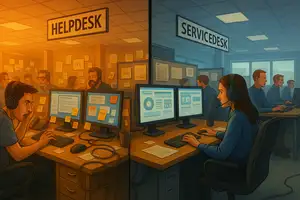
In 2007, I was picked for Mercedes-Benz SveDan as consultant and - at a later date - joined Poolia. Started in the trenches of helpdesk — answering tickets, chasing down locked accounts, plugging in cables that were definitely "already tried" and quietly building the processes and documentation everyone ignored until things broke.
Over time, I helped turn the chaos into a structured "proper" Service Desk and ended up leading it. Alongside that, I worked on GDPR compliance and helped scale our Citrix systems when COVID hit and remote work went from optional to absolutely necessary, practically overnight.
When the support services became outsourced, I moved on as a Field Engineer and eventually shifted again — working as a Technical Specialist with diagnostics and systems for the cars themselves. I handled Xentry, recall campaigns, and reporting to Transportstyrelsen to make sure things were safe, documented, and legal. Usually in that order. Somewhere there, I managed to keep track of multiple internal systems and still remember where I parked when at the office.
In 2021, I was headhunted from Poolia and Mercedes-Benz to join Öresund's IT — a small but well-regarded consultancy focused on IT, where I've finally felt professionally aligned. It was a welcome shift, and I remain thankful for it. That move also took me deeper into public healthcare IT — a world of different rules, older processes, and ancient systems, but similar general madness. It's a sector where change creeps forward under the weight of tradition, policy, and three layers of approval.
Professionals who can lead surgical teams and fix hearts and bones still lose to a forgotten Caps Lock. I'm mostly in second-line application support these days — handling access, chasing bugs, untangling integrations, and trying to explain why systems don't like being poked too hard. It's not flashy, but it's real, and it works — assuming the vendors don't implode and someone actually logged the error.
I've collected a few unofficial titles along the way. Forum admin for Teknikens Värld. Long-time contributor and wrangler for PHP-Fusion — support lead, release manager, Swedish site operator, and occasional herder of digital cats. I've chaired school boards, currently serve in elected office — yes, really — helped more people with their computers than I can count and spent an arguably unhealthy amount of time in the virtual Middle-earth of LotRO, and long before that, charting hyperspace jumps in Homeworld. Homdax and Marancil — nicknames known in their corners of the internet, not for rank or title, but for helping out, keeping things moving, and occasionally stirring the pot with a well-placed post. Not a developer, not a modder — just someone who stuck around, shared knowledge, and helped shape the conversation.
What's kept me going? Curiosity, for one. A certain tolerance for chaos. And the belief that if something doesn't make sense, it's worth figuring out whether it's just bad design, bad decisions, or something people have given up on too early. I may be 60 now, but I still find myself staring at new tools, systems, and interfaces wondering: what is this trying to do, who is it actually for, and could it have been made more intuitive somehow? Not necessarily better in a perfect sense — just more usable, less obscure, and less likely to summon spiritual guidance just to print a PDF — or trigger existential dread during a PowerPoint presentation.
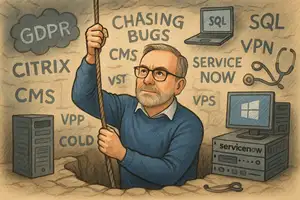
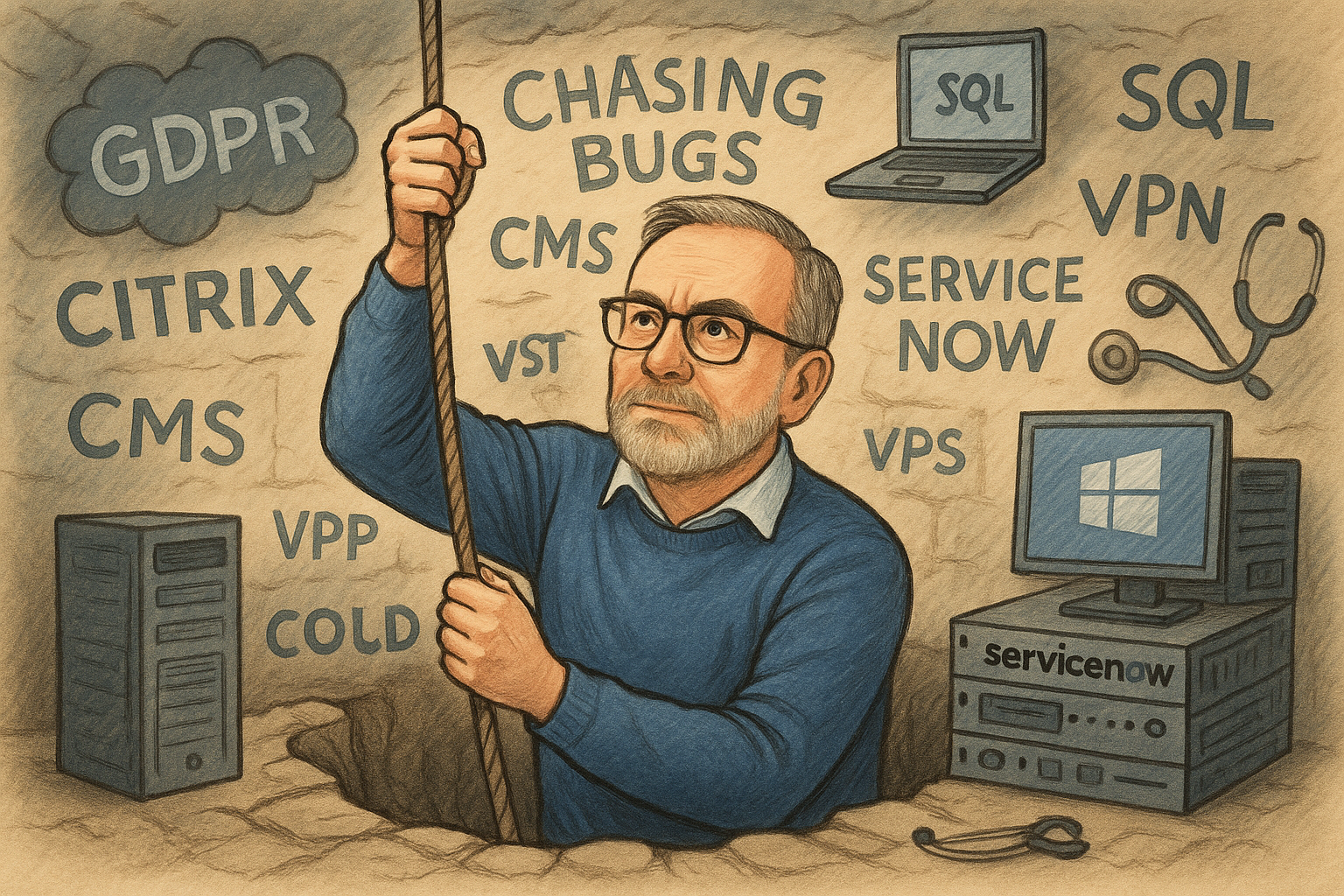
Maybe the rope and the well in the image above is symbolic — or maybe I've just spent 30 years dragging systems, users, and occasionally myself back into daylight.
So here I am. Thirty years into IT. Sixty years into life. Still asking questions, still testing limits, still muttering at cables like they can hear me — and still convinced that turning it off and on again is the closest thing we've got to actual magic.