<?xml version="1.0" encoding="utf-8"?>
<feed xmlns="http://www.w3.org/2005/Atom" xmlns:media="http://search.yahoo.com/mrss/">
    <title>CONRAM.IT</title>
    <link href="https://www.conram.it/feed.xml" rel="self" />
    <link href="https://www.conram.it" />
    <updated>2026-06-05T09:29:58+02:00</updated>
    <author>
        <name>Richard</name>
    </author>
    <id>https://www.conram.it</id>

    <entry>
        <title>SohoLab Has Its Own Home Now</title>
        <author>
            <name>Richard</name>
        </author>
        <link href="https://www.conram.it/soholab-has-its-own-home-now.html"/>
        <id>https://www.conram.it/soholab-has-its-own-home-now.html</id>
        <media:content url="https://www.conram.it/media/posts/46/corpo-vs-homelab-env.png" medium="image" />

        <updated>2026-06-05T08:59:13+02:00</updated>
            <summary type="html">
                <![CDATA[
                        <img src="https://www.conram.it/media/posts/46/corpo-vs-homelab-env.png" alt="Dual worlds" />
                    The Controlled Spin-Off For a while, homelab content lived here alongside everything else — tucked between IT commentary, career writing, and the occasional gaming detour. That was fine when it was occasional. It's not occasional anymore. The homelab has grown into its own ongoing project,&hellip;
                ]]>
            </summary>
        <content type="html">
            <![CDATA[
                    <p><img src="https://www.conram.it/media/posts/46/corpo-vs-homelab-env.png" class="type:primaryImage" alt="Dual worlds" /></p>
                <h2>The Controlled Spin-Off</h2>
<p>For a while, homelab content lived here alongside everything else — tucked between IT commentary, career writing, and the occasional gaming detour. That was fine when it was occasional. It's not occasional anymore.</p>
<p class="font-claude-response-body break-words whitespace-normal leading-[1.7]">The homelab has grown into its own ongoing project, with its own rhythm and its own audience. Mixing rack diagrams and storage controller notes in with service desk rants and browser reviews wasn't doing either side any favours.</p>
<p class="font-claude-response-body break-words whitespace-normal leading-[1.7]">So I've split it out. <strong>SohoLab</strong> now lives at <a class="underline underline underline-offset-2 decoration-1 decoration-current/40 hover:decoration-current focus:decoration-current" href="https://www.conram.it/soholab/index.html">conram.it/soholab</a> — a dedicated space for the home infrastructure project: the hardware, the software, the decisions, and the occasional detour that comes with running a lab at home for reasons that are only partly rational.</p>
<p class="font-claude-response-body break-words whitespace-normal leading-[1.7]">The back catalogue has moved with it. Everything that was homelab in nature is over there now. What stays here is what was always the core of conram.it: IT from a practitioner's perspective, with whatever else catches my attention.</p>
<p class="font-claude-response-body break-words whitespace-normal leading-[1.7]">If you're here for the lab, follow the link. If you're here for the rest — you're already in the right place.</p>
            ]]>
        </content>
    </entry>
    <entry>
        <title>Personal Accounts on Corporate Systems: Why the Boundary Matters</title>
        <author>
            <name>Richard</name>
        </author>
        <link href="https://www.conram.it/personal-accounts-on-corporate-systems-a-boundary-worth-keeping.html"/>
        <id>https://www.conram.it/personal-accounts-on-corporate-systems-a-boundary-worth-keeping.html</id>
        <media:content url="https://www.conram.it/media/posts/42/ChatGPT-Private-Corporate-accounts-mix.png" medium="image" />
            <category term="privacy"/>
            <category term="jobs"/>
            <category term="it"/>
            <category term="gdpr"/>
            <category term="employment"/>
            <category term="cybersecurity"/>
            <category term="corporate"/>

        <updated>2026-03-08T10:12:37+01:00</updated>
            <summary type="html">
                <![CDATA[
                        <img src="https://www.conram.it/media/posts/42/ChatGPT-Private-Corporate-accounts-mix.png" alt="" />
                    Small Habits; Big Consequences “It may sound obvious: don’t mix personal accounts with corporate devices.” At first glance, that advice sounds almost trivial. It tends to be filed alongside password hygiene and basic security awareness; sensible in principle, but hardly the kind of thing that&hellip;
                ]]>
            </summary>
        <content type="html">
            <![CDATA[
                    <p><img src="https://www.conram.it/media/posts/42/ChatGPT-Private-Corporate-accounts-mix.png" class="type:primaryImage" alt="" /></p>
                <h2>Small Habits; Big Consequences</h2>
<p>“It may sound obvious: don’t mix personal accounts with corporate devices.”</p>
<p>At first glance, that advice sounds almost trivial. It tends to be filed alongside password hygiene and basic security awareness; sensible in principle, but hardly the kind of thing that warrants much attention in a leadership meeting.</p>
<p>Yet in practice, the boundary is crossed routinely. An employee signs into a personal Google account on a work laptop. A developer runs a quick test using their own Microsoft identity. Someone checks their private mailbox in the same browser session handling their corporate login.</p>
<p>Each of these situations feels inconsequential. It is only a login, after all, and it takes only a moment. But the moment personal and corporate identities share the same environment, several things begin to happen quietly in the background.</p>
<p>Most people never notice them. That is itself part of the problem.</p>
<h2>What Happens on a Corporate Device</h2>
<p>A corporate device is rarely just a computer. Even in relatively relaxed organisations, it sits inside a managed environment; connected to authentication services, endpoint security tooling and various forms of operational logging designed to keep infrastructure running and reasonably secure.</p>
<p>These systems are hopefully not there to monitor employees in any intrusive sense. They exist because modern IT environments depend on telemetry to detect faults, security incidents and operational anomalies. The practical consequence is that activity on the device produces traces within the organisation’s systems, whether or not anyone is actively watching.</p>
<p>A login event appears in an authentication log. Network connections generate metadata. Endpoint security tools record behaviour in order to identify suspicious patterns. The browser, meanwhile, quietly stores cookies, session tokens and cached content to keep services working smoothly.</p>
<p>When a personal account is introduced into that same environment, its activity becomes part of this technical fabric. The trace of the private activity becomes bundled with the traces of the corporate activity.</p>
<h2>Where Identities Begin to Blur</h2>
<p>The concern is not only one of visibility. It is also the gradual blending of two identities that were never intended to occupy the same space.</p>
<p>Modern authentication systems rely on persistent sessions. Browsers remember logins, if you let them, store tokens and maintain trust relationships with external services to reduce the frequency of password prompts. This works well when a single identity is in play.</p>
<p>When personal and corporate identities share the same environment, those technical artefacts end up sitting side by side. Over time, the boundaries become less distinct. A session persists longer than expected, a file lands in the wrong synchronised folder, or a login prompt appears for the wrong account.</p>
<p>In most cases, nothing immediately dramatic occurs. But the system has quietly lost the clean separation between “private individual” and “employee”. From a security and governance perspective, that separation matters precisely because it removes uncertainty; the kind that tends to resurface at the worst possible moment.</p>
<h2>The Question of Roles and Delegated Authority</h2>
<p>Within a corporate environment, employees do not act solely as individuals. They act under delegated authority. Their accounts may grant access to internal systems, administrative functions, financial data, or customer records.</p>
<p>Personal activity belongs to an entirely different context — one without that authority, and without the associated accountability.</p>
<p>Consider a systems administrator whose corporate account carries elevated privileges. If that individual is also browsing under a personal account within the same session or device environment, the question of which identity was active at a given moment becomes genuinely difficult to answer. During an incident investigation or a compliance audit, that difficulty is not a technicality. It becomes a problem.</p>
<p>A clear separation between personal and professional identities makes that question straightforward to resolve. Mixing them makes the answer considerably less certain, and the audit trail much less useful.</p>
<h2>A Compliance Dimension Worth Taking Seriously</h2>
<p>For organisations operating under European data protection law, there is an additional complication that often goes unacknowledged.</p>
<p>The General Data Protection Regulation imposes a principle of data minimisation: organisations should collect and process only the personal data that is genuinely necessary for a defined and legitimate purpose. Security logging and operational telemetry are generally defensible on those grounds — they serve clear purposes, and regulators understand as much.</p>
<p>However, when employees use personal accounts on corporate devices, those same logging systems may begin capturing traces of personal activity; identifiers, authentication events, or behavioural signals linked to private services the organisation has no business relationship with. The organisation has not sought this data, has no lawful basis for retaining it in a personal capacity, and may not even be aware it is collecting it.</p>
<p>The irony is pointed: what appears to be a minor convenience for the individual quietly expands the organisation’s compliance exposure. The company becomes responsible for handling personal data it never intended to acquire, under the same legal framework governing all other data it processes.</p>
<h2>Different Jurisdictions, the Same Underlying Problem</h2>
<p>Privacy and monitoring legislation varies considerably across the world, and those differences are relevant for any organisation operating across multiple geographies.</p>
<p>In the European Union, monitoring of employee activity on company equipment must generally be proportionate and transparent. Organisations are expected to justify what they collect and why, and employees retain meaningful data protection rights even within the employment relationship. Several member states — Germany being a notable example — layer additional requirements on top of GDPR through national workplace legislation.</p>
<p>In the United States, the picture is more permissive but also more fragmented. Federal law imposes relatively few restrictions on employers monitoring activity on company-owned systems, provided employees have been notified. State-level legislation varies: California’s privacy framework is considerably more protective than most, whilst other states impose minimal constraints. The general principle, however, is that an employer has broad latitude to examine what occurs on its own infrastructure.</p>
<p>What neither jurisdiction can alter is the underlying technical reality. When personal activity takes place on corporate infrastructure, traces of that activity become part of the organisation’s operational data. Legal frameworks determine how that data may be used or retained — and what obligations attach to it — but they do not prevent it from existing in the first place.</p>
<p>For CTOs and CISOs managing environments that span both regulatory contexts, this asymmetry is worth bearing in mind. The threshold for what is permissible differs. The technical consequence of mixed identities does not.</p>
<h2>A Simple Rule That Still Matters</h2>
<p>Separating personal and corporate identities is therefore more than a minor security hygiene measure. It protects several interests simultaneously: it preserves a meaningful degree of personal privacy for the employee, keeps the organisation’s operational systems cleaner, reduces unintended compliance exposure, and maintains a clear boundary between private life and professional responsibility.</p>
<p>For security and technology leaders, it is also worth recognising that this boundary is not self-enforcing. It requires deliberate policy, consistent tooling — such as managed browser profiles, device enrolment, and clear acceptable-use guidance — and occasional reminders that convenience and security are not always pointing in the same direction.</p>
<p>The underlying rule, however, remains straightforward.</p>
<p>Personal identities belong on personal systems. Corporate identities belong within corporate environments.</p>
<p>In a world where digital systems constantly blur these boundaries, maintaining that one clear line is still very much worth the effort.</p>
<h3>References:</h3>
<ol>
<li><strong>GDPR — Core Principles (Data Minimisation, Purpose Limitation)<br></strong><a href="https://gdpr.eu/article-5-how-to-process-personal-data/" target="_blank" rel="noopener noreferrer">https://gdpr.eu/article-5-how-to-process-personal-data/</a></li>
<li><strong>Data Protection Guide for Small Businesses</strong> <br><a href="https://www.edpb.europa.eu/sme-data-protection-guide/home_en" target="_blank" rel="noopener noreferrer">https://www.edpb.europa.eu/sme-data-protection-guide/home_en</a> </li>
<li><strong> European Court of Human Rights — Bărbulescu v. Romania</strong><br><a href="https://hudoc.echr.coe.int/eng?i=001-177082" target="_blank" rel="noopener noreferrer">https://hudoc.echr.coe.int/eng?i=001-177082</a></li>
<li><strong> UK Information Commissioner’s Office (ICO) — Monitoring at Work</strong><br><a href="https://ico.org.uk/for-organisations/uk-gdpr-guidance-and-resources/employment/monitoring-workers/" target="_blank" rel="noopener noreferrer">https://ico.org.uk/for-organisations/uk-gdpr-guidance-and-resources/employment/monitoring-workers/</a></li>
<li><strong> NIST Digital Identity Guidelines (General Identity Hygiene)</strong><br><a href="https://pages.nist.gov/800-63-3/" target="_blank" rel="noopener noreferrer">https://pages.nist.gov/800-63-3/</a></li>
<li><strong> ENISA — Cybersecurity Culture Guidelines</strong><br><a href="https://www.enisa.europa.eu/publications/cybersecurity-culture-guidelines-behavioural-aspects-of-cybersecurity" target="_blank" rel="noopener noreferrer">https://www.enisa.europa.eu/publications/cybersecurity-culture-guidelines-behavioural-aspects-of-cybersecurity</a></li>
</ol>
            ]]>
        </content>
    </entry>
    <entry>
        <title>Why Gigabit Underwhelms</title>
        <author>
            <name>Richard</name>
        </author>
        <link href="https://www.conram.it/why-ones-gigabit-feels-rather-pedestrian.html"/>
        <id>https://www.conram.it/why-ones-gigabit-feels-rather-pedestrian.html</id>
        <media:content url="https://www.conram.it/media/posts/41/victrorian-speed-test.png" medium="image" />
            <category term="service"/>
            <category term="network"/>
            <category term="isp"/>

        <updated>2025-11-26T14:04:32+01:00</updated>
            <summary type="html">
                <![CDATA[
                        <img src="https://www.conram.it/media/posts/41/victrorian-speed-test.png" alt="Gigabit speeds" />
                    A Lamentable Tale of Modern Commerce You've done it. After considerable correspondence with your service provider—including several tersely worded letters that would make the family solicitor proud—you've finally secured that rather splendid 1Gbps fibre connection. The technician departs, you conduct a speed test, and there&hellip;
                ]]>
            </summary>
        <content type="html">
            <![CDATA[
                    <p><img src="https://www.conram.it/media/posts/41/victrorian-speed-test.png" class="type:primaryImage" alt="Gigabit speeds" /></p>
                <div class="post__toc">
<h3>Table of Contents</h3>
<ul>
<li><a href="#mcetoc_1jb07b6pcna">A Lamentable Tale of Modern Commerce</a></li>
<li><a href="#mcetoc_1jb07b6pcnb">What Has Actually Been Purchased</a></li>
<li><a href="#mcetoc_1jb07b6pcnc">The Bottleneck Parade</a></li>
<li><a href="#mcetoc_1jb07b6pcnh">The Concurrent Connection Casino</a></li>
<li><a href="#mcetoc_1jb07b6pcni">CDN Lottery: Location, Location, Location</a></li>
<li><a href="#mcetoc_1jb07b6pcnj">When Does Gigabit Actually Prove Worthwhile?</a></li>
<li><a href="#mcetoc_1jb07b6pcnk">The Rather Uncomfortable Financial Proposition</a></li>
<li><a href="#mcetoc_1jb07b6pcnl">The Regulatory Smokescreen</a></li>
<li><a href="#mcetoc_1jb07b6pcnm">The Actual Question</a></li>
</ul>
</div>
<h3 id="mcetoc_1jb07b6pcna"><strong>A Lamentable Tale of Modern Commerce</strong></h3>
<p>You've done it. After considerable correspondence with your service provider—including several tersely worded letters that would make the family solicitor proud—you've finally secured that rather splendid 1Gbps fibre connection. The technician departs, you conduct a speed test, and there it is: 950Mbps down. Marvellous. You immediately endeavour to download that 4GB Linux ISO you've been meaning to examine, and... 6MB/s.</p>
<p>Six. Megabytes. Per. Second.</p>
<p>You check the speed test again. Still nearly a gigabit. You reboot the router—naturally, as one does—still 6MB/s. Congratulations: you've just learnt what your ISP's marketing department had absolutely no intention of disclosing.</p>
<h3 id="mcetoc_1jb07b6pcnb"><strong>What Has Actually Been Purchased</strong></h3>
<p>Here's the rather uncomfortable reality: your ISP has sold you a frightfully fast connection to <em>their</em> network. That's all. Rather like having a perfectly maintained private drive from the manor to the village road, only to discover the King's Highway beyond remains the same potholed disgrace it's always been.</p>
<p>The 1Gbps represents the speed between your residence and the ISP's equipment, full stop. Everything beyond that depends on infrastructure your ISP neither owns nor controls, and certainly shan't mention in their rather vulgar advertising. Why would they? It's far more profitable to let you discover the truth after you've signed the contract.</p>
<h3 id="mcetoc_1jb07b6pcnc"><strong>The Bottleneck Parade</strong></h3>
<p>Let us examine why a gigabit connection resembles rather taking the Bentley into Central London during rush hour:</p>
<ol>
<li id="mcetoc_1jb07b6pcnd"><strong>Your Own Wireless Apparatus<br></strong>Before blaming anyone else, one must address the elephant in the room: your WiFi. That router the ISP provided? It's using WiFi 5 technology from 2014, capable of ‘up to’ a gigabit in laboratory conditions, provided one is seated atop the router and has politely asked the laws of physics to step aside. In your actual residence, with three walls, a microwave, and the neighbour's seventeen wireless networks competing for the same channels, you're getting perhaps 150Mbps. Congratulations, you've just paid for gigabit speeds and immediately throttled them by 85% through your own wireless network. One could, of course, use an Ethernet cable, but that would require effort and admitting the expensive WiFi router isn't quite as magical as advertised. Frightfully inconvenient.<br><br></li>
<li id="mcetoc_1jb07b6pcne"><strong>Server Inadequacy<br></strong>That obscure open-source project you're downloading? It's hosted on some frightfully cheap virtual server that costs €5 monthly and shares a 100Mbps connection with forty other websites of questionable pedigree. One suspects the hosting was purchased by someone's nephew who "knows about computers." Even if your connection could retrieve data at 1Gbps, this server would merely wheeze apologetically and transmit packets at whatever speed its rather inadequate resources permit. Pathetic, really.<br><br></li>
<li id="mcetoc_1jb07b6pcnf"><strong>Peering and Transit: The Geopolitics of Packets<br></strong>Your data doesn't simply materialise at your residence. It traverses multiple networks, each owned by different commercial enterprises who may harbour considerable animosity toward one another. If your ISP and their peering partner are having a pricing disagreement, rather like neighbouring estates disputing water rights, except with less dignity, your data packets are redirected through alternative routes already suffering from congestion. One imagines suited executives arguing over fractions of pennies per gigabyte whilst your download crawls along. Dreadful business.<br><br></li>
<li id="mcetoc_1jb07b6pcng"><strong>Geographic Reality: <br>Physics Remains Obstinately Uncooperative<br></strong>Latency remains bound by the speed of light through glass fibre. A server in Tokyo sits approximately 9,000 kilometres distant. Even in ideal circumstances, that represents roughly 60 milliseconds merely for the return journey, before any actual routing complications. Factor in the aforementioned peering nonsense, and you face 200-300ms response times. Physics, regrettably, remains unimpressed by one's monthly subscription fees.</li>
</ol>
<h3 id="mcetoc_1jb07b6pcnh"><strong>The Concurrent Connection Casino</strong></h3>
<p>That popular software release everyone's clamouring for? The server may possess a 10Gbps connection, but it's presently serving 2,000 simultaneous downloads. Your allocation of bandwidth becomes rather... modest. Much like being promised unlimited champagne at a Garden Party, only to discover several dozen invitees queuing at a single bottle whilst the staff claim everything is proceeding according to plan.</p>
<h3 id="mcetoc_1jb07b6pcni"><strong>CDN Lottery: Location, Location, Location</strong></h3>
<p>Content Delivery Networks are the only reason the internet functions at all, rather like having proper staff who actually should know what they're doing. Netflix, Steam, Microsoft—they cache content locally. When it works splendidly, you achieve those glorious gigabit speeds. When it doesn't—because the content provider was too penny-pinching to invest in proper infrastructure—you're pulling data from a solitary origin server that might as well be situated on the grouse moor in Scotland.</p>
<h3 id="mcetoc_1jb07b6pcnj"><strong>When Does Gigabit Actually Prove Worthwhile?</strong></h3>
<p>Despite considerable cynicism, there exist legitimate circumstances where gigabit connections justify their expense. Mind you, these are considerably rarer than the marketing suggests:</p>
<ul>
<li><strong>Multiple Occupants Conducting Various Activities</strong>: Four persons in residence, all streaming the telly simultaneously whilst someone conducts a video conference? That's where bandwidth matters. Four simultaneous streams plus gaming? Now you're actually utilising that capacity—assuming everyone else's infrastructure cooperates.<br><br></li>
<li><strong>Services of Proper Quality</strong>: Steam, Microsoft, Apple, major cloud providers—these organisations actually invested in proper infrastructure. When the opposite end isn't operated by absolute peasants cutting costs at every turn, gigabit performs admirably. Pity there aren't more of them.<br><br></li>
<li><strong>Upload Speeds (The Unsung Virtue)</strong>: Here's what ISPs fail to advertise properly: gigabit fibre typically means gigabit <em>upload</em> as well. Working from home transmitting substantial files? Video conferences where you're actually broadcasting in high definition rather than resembling a pixelated ghost? Upload speed is where you notice the difference daily, even if downloads prove disappointing.<br><br></li>
<li><strong>Future-Proofing (Potentially)</strong>: Television broadcasts grow increasingly corpulent. Standard streaming progresses from HD to 4K. Eventually, 8K shall cease being ridiculous and become standard, because apparently we need to see individual pores on newsreaders' faces. Whether you actually notice the distinction on your screen remains debatable, but the file sizes unquestionably increase.</li>
</ul>
<h3 id="mcetoc_1jb07b6pcnk"><strong>The Rather Uncomfortable Financial Proposition</strong></h3>
<p>Right, let us discuss finances. You pay €60 monthly for gigabit. Your neighbour pays €30 monthly for 100Mbps. Let us be brutally honest: you notice the speed differential perhaps 20% of the time—when downloading from services with proper infrastructure, or when multiple persons utilise the connection simultaneously. The remainder? You're paying extra to arrive at identical bottlenecks ten times more rapidly.</p>
<p>Single occupant residence? You're almost certainly squandering money unless you work from home with significant upload requirements. Multi-occupant household with everyone streaming and gaming? The extra €360 annually is probably justified. Possibly.</p>
<p>But here's the truly uncomfortable aspect: you likely upgraded because gigabit <em>sounds</em> impressive. Your acquaintances expressed admiration when you mentioned it. You desired the finest available. None of these constitute rational justifications for spending €360 annually extra, but they're precisely why ISPs promote gigabit packages with such enthusiasm. They're not fools—they know perfectly well that most customers shan't notice the difference, but they also know people shall pay regardless. It's rather like selling premium petrol to someone driving a Ford Fiesta.</p>
<h3 id="mcetoc_1jb07b6pcnl"><strong>The Regulatory Smokescreen</strong></h3>
<p>Here's how ISPs execute this brilliantly legal prestidigitation: regulations require them to deliver advertised speeds to <em>their network</em>—and they do. In the EU, consumer protection laws hold them accountable for the connection from your router to their equipment. Job accomplished, box ticked, regulatory obligations satisfied.</p>
<p>Speeds to the broader internet? Not their concern, what. Regulations cease at the edge of their network. How frightfully convenient for the ISPs, and how utterly useless for consumers.</p>
<p>The United States proves even more uncivilised about it. "Up to" gigabit speeds with virtually no accountability for what transpires beyond the ISP's infrastructure. One rather suspects American ISPs looked at the EU regulations, had a good laugh, and carried on doing exactly as they pleased.</p>
<p>Both regions share the same fundamental regulatory deficiency: laws concentrate on the last-mile connection but utterly disregard the reality that internet performance depends on infrastructure the ISP neither owns nor controls. It's brilliantly convenient for marketing departments—who can legally advertise gigabit speeds whilst knowing full well most customers shan't experience them—and entirely useless for consumers attempting to comprehend why their expensive connection feels pedestrian.</p>
<h3 id="mcetoc_1jb07b6pcnm"><strong>The Actual Question</strong></h3>
<p>The cynical truth? ISPs market gigabit connections because they sound impressive and permit higher charges. It's not fraud—you genuinely receive that speed to their network—but it's certainly not the complete picture. Rather like selling someone a thoroughbred racehorse whilst neglecting to mention the village roads are too narrow to gallop on.</p>
<p>They're banking on consumers failing to understand that the internet constitutes a cooperative endeavour involving thousands of networks, most of which care nothing whatsoever for your last-mile speed. Why should they? They're not receiving any portion of your €60 monthly subscription. Your ISP pockets that entirely whilst shrugging helplessly about everyone else's infrastructure inadequacies.</p>
<p>Next time you observe an advertisement promising "lightning-fast gigabit speeds," simply append mentally: "*to our network, after which all assurances are void, terms and conditions apply, servers may vary, not responsible for the rest of the internet, your experience will most definitely vary, and frankly we're rather counting on you not understanding any of this until after you've signed the contract."</p>
<p>Your 1Gbps connection is genuine. Your ability to utilise it? That depends on whether everyone else along the chain bothered to upgrade their infrastructure.</p>
<p>Spoiler: they mostly didn't. Frightfully inconsiderate, really. But then, why should they spend money improving infrastructure when your ISP is already collecting premium fees for services only partially delivered? The whole arrangement works brilliantly—for everyone except you, naturally.</p>
<p> </p>
            ]]>
        </content>
    </entry>
    <entry>
        <title>Helpdesk ≠ ServiceDesk ≠ Helpdesk</title>
        <author>
            <name>Richard</name>
        </author>
        <link href="https://www.conram.it/helpdesk-servicedesk-helpdesk.html"/>
        <id>https://www.conram.it/helpdesk-servicedesk-helpdesk.html</id>
        <media:content url="https://www.conram.it/media/posts/34/HelpDeskvsServiceDesk.png" medium="image" />
            <category term="servicedesk"/>
            <category term="service"/>
            <category term="life"/>
            <category term="itsm"/>
            <category term="itil"/>
            <category term="it"/>
            <category term="helpdesk"/>
            <category term="firefight"/>
            <category term="economics"/>
            <category term="documentation"/>

        <updated>2025-10-12T12:33:24+02:00</updated>
            <summary type="html">
                <![CDATA[
                        <img src="https://www.conram.it/media/posts/34/HelpDeskvsServiceDesk.png" alt="Helpdesk-ServiceDesk" />
                    Introduction – When Definitions Collapse In IT, we drown in titles with thin definitions; new ones appear each year while the old are simply repainted. Somewhere along the way, we forgot that definitions exist for a reason. Unlike regulated professions—medicine, law, engineering—our field allows anyone&hellip;
                ]]>
            </summary>
        <content type="html">
            <![CDATA[
                    <p><img src="https://www.conram.it/media/posts/34/HelpDeskvsServiceDesk.png" class="type:primaryImage" alt="Helpdesk-ServiceDesk" /></p>
                <h3>Introduction – When Definitions Collapse</h3>
<p>In IT, we drown in titles with thin definitions; new ones appear each year while the old are simply repainted. Somewhere along the way, we forgot that definitions exist for a reason. Unlike regulated professions—medicine, law, engineering—our field allows anyone to claim any title they like. There is little protection, and standards lack upholding. Certification bodies such as Cisco, Microsoft, or Axelos set frameworks for individuals; yet entire organizations operate under those titles without the faintest notion of what they imply. The result is a theatre of prestige labels worn like costumes; accountability remains an afterthought.</p>
<p>This is not about individuals; it is about structure, responsibility, and integrity. IT’s vocabulary used to mean something. A Helpdesk was a Helpdesk. A ServiceDesk was a defined function, not a marketing term. These distinctions emerged for good reason. In the 1980s, Helpdesks handled reactive user support; pure firefighting. The 1990s brought ITIL and the concept of Service Management; IT was no longer just about fixing but about delivering. By the 2000s, ITSM and ISO/IEC 20000 introduced governance and maturity models. Then digital transformation, outsourcing, and automation blurred those boundaries again. Now, we find ourselves back where we started; only with shinier tools and less clarity.</p>
<p>For context, see <em><a href="https://www.conram.it/the-never-ending-it-firefight.html" target="_blank" rel="noopener">The Never-Ending IT Firefight</a></em>, where I explored how support work degenerates under turnover, lost documentation, and vanishing accountability. This text continues that discussion; because before we can fix the system, we must call things what they truly are.</p>
<h3>Helpdesk – Firefighting by Design</h3>
<p>A Helpdesk is the reactive layer of IT support; the first to see the flames and the last to get proper training. It exists to restore function, not to manage quality. Its key metrics—ticket volume, closure rate, time-to-resolution—create an illusion of efficiency while rewarding only speed. The faster the fix, the better the score; never mind if the issue resurfaces next week.</p>
<p>The Helpdesk model, born from necessity, is transactional by design. Its strength lies in triage and basic troubleshooting; but without systemic feedback or analytical time, it becomes a treadmill. There is no reflection, no improvement; only motion. Escalations multiply, documentation stalls, and the same problems keep returning like clockwork.</p>
<p>This isn’t the fault of the staff; most are doing their best with little context, minimal authority, and constant pressure to close tickets. The real problem is structural. A Helpdesk built on throughput metrics cannot evolve; it becomes a containment mechanism for dysfunction rather than a bridge to resolution.</p>
<h3>ServiceDesk – Structure, Not Cosmetics</h3>
<p>A ServiceDesk is supposed to be something else entirely; not an improved Helpdesk, but a different function built on maturity and management. In ITIL v4, the <em>Service Desk practice</em> is the single point of contact for incidents and requests—a communication hub that manages not just problems but expectations <a href="#ref1" class="footnote">[1]</a>. It bridges operational delivery with business outcomes; tying user needs to the broader value chain <a href="#ref2" class="footnote">[2]</a>. A ServiceDesk is intended to serve as a single point of contact for all user service needs; not only fire-calls <a href="#ref3" class="footnote">[3]</a>.</p>
<p>A proper ServiceDesk owns visibility, analysis, and improvement. It connects incident, problem, and change management; it documents, follows trends, and participates in the prevention of recurrence <a href="#ref4" class="footnote">[4]</a>. It is the operational conscience of IT; <strong>not its call centre.</strong></p>
<p>Modern practice expands this further. Self-service portals, chatbots, and AI-driven knowledge systems automate routine requests; a mature ServiceDesk uses the data these generate to refine service patterns and guide users intelligently. The difference lies in attitude; a Helpdesk works case-by-case, a ServiceDesk manages the ecosystem.</p>
<h3>The False Transition – Labels Without Change</h3>
<p>This is where the frustration begins; countless organizations claim to have “evolved” from Helpdesk to ServiceDesk, yet when examined, nothing truly changed. The same daily grind persists; the same ticket floods, the same blind escalations, the same race to meet meaningless metrics. The only transformation was in terminology.</p>
<p>It is astonishing how often leadership equates rebranding with progress. A slide deck, a new workflow tool, and a few borrowed ITIL phrases; suddenly, there it is—a “ServiceDesk.” Never mind that no Service Management processes exist, no roles are defined, and no one understands what a Problem record even is.</p>
<p>This false transition happens because management wants improvement without investment; maturity without change. It is easier to rename than to reform. Vendors encourage this illusion as well; selling platforms and calling them “ITSM solutions,” when in reality they are only glorified ticket trackers. Tools cannot create maturity; structure and culture do.</p>
<p>The most damaging part of this charade is that it tricks everyone. Management believes progress was made; staff believe they work in a professional environment; customers believe they are covered by SLAs. Beneath the veneer, the machine still runs on chaos. The ServiceDesk name is worn proudly while none of its responsibilities are fulfilled.</p>
<h3>Why It Happens – Budgets, Incentives, and Blind Spots</h3>
<p>Why does this pattern repeat? Because it is cheaper to appear mature than to become mature. The cause is neither malice nor stupidity; it is economic gravity. Budgets are tight, priorities short-term, and incentives misaligned.</p>
<p>Organizations optimize for visible output, not lasting stability. Tickets closed per day look impressive on paper; a well-documented root cause analysis does not. Management dashboards reward volume, not learning. Improvement takes time; time costs money. The outcome is predictable: repeat incidents are tolerated, knowledge work is neglected, and the idea of continuous improvement remains a slide in a presentation.</p>
<p>There is also a psychological component. IT departments often believe that implementing a framework automatically makes them compliant with it; the framework becomes decoration, not discipline. Few leaders actually read what ITIL defines; fewer still apply it correctly. The result is not incompetence, but complacency; a quiet acceptance of “good enough,” reinforced by KPIs that measure the wrong thing.</p>
<h3>The Vacuum Between – Where Problems Go to Hide</h3>
<p>Between Helpdesk and ServiceDesk lies a vacuum; a grey zone of ownership where recurring issues, undocumented workarounds, and “temporary” fixes pile up until they become permanent. This is where problems go to hide.</p>
<p>Tickets circulate endlessly between first- and second-line support; knowledge is neither captured nor transferred. Users repeat the same symptoms, technicians repeat the same resolutions, and the system reports a false sense of activity. The busier it looks, the less it achieves.</p>
<p>Inside this vacuum, accountability evaporates. Nobody owns the underlying cause. Management receives clean reports—tickets opened, tickets closed—and assumes progress. Meanwhile, technical debt accumulates quietly in the background. Documentation becomes ritualistic; the minimum text to satisfy a closure rule. Over time, teams forget that documentation was supposed to teach; not just to tick a box.</p>
<p>From the inside, it feels like an endless treadmill; from the outside, it looks like productivity. In reality, it is stagnation disguised as motion.</p>
<h3>Reform – A Modest Path Forward</h3>
<p>Helpdesk or ServiceDesk? Reactive chaos or structured accountability? The distinction is not academic; it determines whether IT support remains a profession or collapses into industrialized scriptwork.</p>
<p>If words are to mean anything again, then reform must begin with integrity. Stop naming things what they are not. If you run a Helpdesk, call it that; then build from there. The transition to a ServiceDesk is not a cosmetic upgrade; it is a cultural, procedural, and managerial evolution.</p>
<p>Criticism without prescription is hollow; so here is the prescription.</p>
<ul>
<li>Map where your organization truly stands on the maturity continuum—from reactive to proactive to business-aligned—using models such as HDI’s Service Desk maturity framework <a href="#ref5" class="footnote">[5]</a>.</li>
<li>Define clear ownership boundaries. Know what the Helpdesk should solve and where the ServiceDesk begins; do not blur the two for convenience.</li>
<li>Make every escalation meaningful. If you forward a ticket, attach context; data, reasoning, and possible cause. Escalation is not abdication.</li>
<li>Invest in structure before software. A new tool will not compensate for a broken process.</li>
<li>Document for knowledge, not compliance. Write to teach; not to prove that a checkbox was filled.</li>
<li>Measure value, not volume. Count resolved causes, not closed tickets. Stability is an achievement; not an absence of work.</li>
<li>And finally—hold leadership to the same standards as the staff. If management claims to deliver service, it must also embody Service Management.</li>
</ul>
<p>A polished title will not fix broken systems; a ServiceDesk without service is only a name. But a name used honestly—with discipline, accountability, and structure—can restore meaning; and perhaps even respect; to a profession that has been too long misunderstood.</p>
<h3 id="references">References</h3>
<ol class="references">
<li id="ref1">Axelos, <em>ITIL® 4 Foundation</em>, 2019 – Defines the Service Desk as the single point of contact for users and communication hub in service management.</li>
<li id="ref2"><a href="https://itsm.tools/itil-4-service-desk-practice-guide" target="_blank" rel="noopener">itsm.tools</a>, <em>ITIL 4 Service Desk Practice Guide Summary</em>, 2023 – Describes the Service Desk as a cross-value-stream practice connecting users and services.</li>
<li id="ref3"><a href="https://www.atlassian.com/itsm/service-request-management/help-desk-vs-service-desk-vs-itsm" target="_blank" rel="noopener">Atlassian</a>, <em>Help Desk vs Service Desk vs ITSM</em>, 2024 – Clarifies that a Service Desk manages all user interactions; not only incidents.</li>
<li id="ref4"><a href="https://www.knowledgehut.com/blog/it-service-management/itil-service-desk" target="_blank" rel="noopener">KnowledgeHut</a>, <em>ITIL Service Desk: Overview and Functions</em>, 2023 – Outlines Service Desk integration with problem, change, and knowledge management.</li>
<li id="ref5"><a href="https://www.thinkhdi.com/library/supportworld/2023/transform-existing-help-desk" target="_blank" rel="noopener">HDI</a>, <em>Transform Your Existing Help Desk into a Modern Service Desk</em>, 2023 – Introduces the HDI Service Desk maturity continuum and improvement roadmap.</li>
</ol>
<h3>About This Article</h3>
<p>This article continues my reflections on the structural and cultural flaws within IT support, being the most visible layer of any IT organisation. It is written from experience, but not aimed at any one organisation or individual. The tone may sound frustrated—because it is—but the intent is constructive: to remind readers that words like “Service” and “Management” carry obligations, not just aesthetics. If the piece provokes a moment of recognition or discomfort, then it has done its job; progress begins when terminology meets integrity.</p>
            ]]>
        </content>
    </entry>
    <entry>
        <title>More Than a CV</title>
        <author>
            <name>Richard</name>
        </author>
        <link href="https://www.conram.it/the-cv-is-a-story.html"/>
        <id>https://www.conram.it/the-cv-is-a-story.html</id>
        <media:content url="https://www.conram.it/media/posts/29/career-milestones.png" medium="image" />
            <category term="linkedin"/>
            <category term="life"/>
            <category term="jobs"/>
            <category term="it"/>
            <category term="employment"/>
            <category term="economics"/>
            <category term="cv"/>
            <category term="consultant"/>

        <updated>2025-09-24T19:34:53+02:00</updated>
            <summary type="html">
                <![CDATA[
                        <img src="https://www.conram.it/media/posts/29/career-milestones.png" alt="Career milestones" />
                    I recently opened a print preview of my CV. Almost seven pages — well over 10,000 characters. At that point you’re no longer holding a résumé, you’re holding a white paper on your own career. Do you expect a recruiter to read that? The reason&hellip;
                ]]>
            </summary>
        <content type="html">
            <![CDATA[
                    <p><img src="https://www.conram.it/media/posts/29/career-milestones.png" class="type:primaryImage" alt="Career milestones" /></p>
                <p data-start="265" data-end="438">I recently opened a print preview of my CV. Almost seven pages — well over 10,000 characters. At that point you’re no longer holding a résumé, you’re holding a white paper on your own career. Do you expect a recruiter to read that?</p>
<p data-start="440" data-end="594">The reason I even looked? I’m currently preparing for new assignments. And that means dusting off the CV, something most of us only do when we need to. Republishing it, rewriting it, review its structure and readability.</p>
<h3 data-start="440" data-end="594">Beyond Jobs and Dates</h3>
<p data-start="440" data-end="594">A CV is not just a list of jobs and dates. It is a story, a personal timeline of work, choices, and growth. Some chapters are long and steady, others are short, intense, and full of change. Some read like turning points, others more like side quests.</p>
<p data-start="440" data-end="594">And it is not only about employment. It is also about what kept those jobs possible, the trainings and courses that added new skills, and the private efforts that quietly shaped the professional ones. A CV holds more than positions — it holds the context around them.</p>
<p data-start="971" data-end="1053">The challenge is that stories have different versions depending on the audience.</p>
<ul>
<li data-start="1057" data-end="1210"><strong data-start="1057" data-end="1077">The full edition</strong>: the long CV. This is the archive, the complete record, everything that shaped you. It can run six or seven pages without apology.</li>
<li data-start="1213" data-end="1389"><strong data-start="1213" data-end="1238">The condensed edition</strong>: a résumé. One or two pages that show the highlights, the turning points, the impact. Enough to get attention without drowning the reader in detail.</li>
<li data-start="1392" data-end="1514"><strong data-start="1392" data-end="1405">The blurb</strong>: a short profile or summary. The “back cover text” that sparks curiosity and leaves room for conversation.</li>
</ul>
<p data-start="1516" data-end="1730">The trick is not just cutting text, but considering perspective. The same story can be told as a chronicle, as a highlight reel, or as an elevator pitch. Each version has its place and, perhaps, its own audience.</p>
<p data-start="1607" data-end="1882">Working through mine reminded me of something important: the CV is not only for others. It is also for yourself. It forces you to step back and reflect. To connect the dots across years and projects. To see the through-line that might not have been obvious while living it.</p>
<p data-start="1884" data-end="2058">That is why I now think of the CV as a <em data-start="1923" data-end="1940">living document</em>. Updating it is not a chore. It’s a chance to look back, to take stock, and to think about where you’re going next.</p>
<p data-start="1884" data-end="2058">While that is true it also raises another question, do I write a 20 pages life history based upon what is in my CV? I could, most of you who read this could also, maybe some have. It would not be for HR or ATS systems though, but for friends and relatives to read about what you did in that circumstance on that workplace.</p>
<p data-start="1884" data-end="2058">Food for thought.</p>
            ]]>
        </content>
    </entry>
    <entry>
        <title>30 Years in IT, 60 in Life — and Still Running Patches</title>
        <author>
            <name>Richard</name>
        </author>
        <link href="https://www.conram.it/30-years-in-it-60-in-life-and-still-running-patches.html"/>
        <id>https://www.conram.it/30-years-in-it-60-in-life-and-still-running-patches.html</id>
        <media:content url="https://www.conram.it/media/posts/22/30-60.png" medium="image" />
            <category term="servicedesk"/>
            <category term="linkedin"/>
            <category term="life"/>
            <category term="internet"/>
            <category term="helpdesk"/>
            <category term="economics"/>
            <category term="documentation"/>
            <category term="birthday"/>

        <updated>2025-06-16T16:29:40+02:00</updated>
            <summary type="html">
                <![CDATA[
                        <img src="https://www.conram.it/media/posts/22/30-60.png" alt="" />
                    Repost from LinkedIn One says I'm getting old. The other says I'm just getting better at fixing things people shouldn't have broken in the first place. This isn't a CV. It's a glimpse at what I've learned, built, broken, and survived — from retail stockrooms&hellip;
                ]]>
            </summary>
        <content type="html">
            <![CDATA[
                    <p><img src="https://www.conram.it/media/posts/22/30-60.png" class="type:primaryImage" alt="" /></p>
                <p class="align-right">Repost from <a href="https://www.linkedin.com/pulse/30-years-60-life-still-running-patches-rikard-malmborg-ha5yf/" target="_blank" rel="noopener noreferrer">LinkedIn</a></p>
<h2><strong>This spring, I hit two milestones: 60 years of life, and 30 years in IT.</strong></h2>
<p>One says I'm getting old. The other says I'm just getting better at fixing things people shouldn't have broken in the first place.</p>
<p>This isn't a CV. It's a glimpse at what I've learned, built, broken, and survived — from retail stockrooms to server racks, from modding forums to public healthcare, from an IBM Aptiva to AI. It's also a thank-you to the systems, users, leaders, and digital worlds that shaped my perspective — namely, that formal training is nice, but lived chaos teaches faster.</p>
<p>You know who you are, you are still here – with very few exceptions, right there in my connections list.</p>
<hr>
<p>I've spent three decades navigating the digital world — building, breaking, fixing, and occasionally muttering at machines until they listened. From shell prompts to diagnostic platforms, CMS systems to GDPR audits, and support tickets to strategic headaches, I've seen the loop from both ends. These days, I even let AI help me write things like this. Not because I need it, but because it's a damn useful tool — when guided by experience and the knowhow that hopefully goes with it.</p>
<p>I enjoy new tech, but I look for what actually works. Practicality, usability, and — ideally — something you can implement without holding a séance. Shiny features are fine but give me a tool that doesn't panic in production. Curiosity and hands-on experience have taken me further than any buzzword ever did.</p>
<p>It started back in 1995 with an IBM Aptiva. Sure, I'd messed with BASIC in the '80s while helping out in my parents' perfume and cosmetics business in Mallorca. I managed stock, sales, logistics — and developed a lifelong skill for spotting when someone spends too much on makeup and too little on actually looking good. But the Aptiva? That was the turning point. Mine to break, mine to learn from. Windows greeted me with a crash. I greeted it with stubbornness. We've been in a relationship ever since.</p>
<p>After a few years of evening courses and technical dabbling, I launched my own consultancy in 2000 — CONRAM — because enough companies were asking for help and freelance sounded better than "doing everything without benefits." I built websites, packaged software, managed projects, and kept clients up and running, sometimes in spite of themselves. Java apps, MSI installers, duct tape logic — I worked across the board with outfits like Framfab and WM-data and learned what makes systems tick. Or stop ticking.</p>
<p>In 2007, I was picked for Mercedes-Benz SveDan as consultant and - at a later date - joined Poolia. Started in the trenches of helpdesk — answering tickets, chasing down locked accounts, plugging in cables that were definitely "already tried" and quietly building the processes and documentation everyone ignored until things broke.</p>
<p>Over time, I helped turn the chaos into a structured "proper" Service Desk and ended up leading it. Alongside that, I worked on GDPR compliance and helped scale our Citrix systems when COVID hit and remote work went from optional to absolutely necessary, practically overnight.</p>
<p>When the support services became outsourced, I moved on as a Field Engineer and eventually shifted again — working as a Technical Specialist with diagnostics and systems for the cars themselves. I handled Xentry, recall campaigns, and reporting to Transportstyrelsen to make sure things were safe, documented, and legal. Usually in that order. Somewhere there, I managed to keep track of multiple internal systems and still remember where I parked when at the office.</p>
<p>In 2021, I was headhunted from Poolia and Mercedes-Benz to join Öresund's IT — a small but well-regarded consultancy focused on IT, where I've finally felt professionally aligned. It was a welcome shift, and I remain thankful for it. That move also took me deeper into public healthcare IT — a world of different rules, older processes, and ancient systems, but similar general madness. It's a sector where change creeps forward under the weight of tradition, policy, and three layers of approval.</p>
<p>Professionals who can lead surgical teams and fix hearts and bones still lose to a forgotten Caps Lock. I'm mostly in second-line application support these days — handling access, chasing bugs, untangling integrations, and trying to explain why systems don't like being poked too hard. It's not flashy, but it's real, and it works — assuming the vendors don't implode and someone actually logged the error.</p>
<p>I've collected a few unofficial titles along the way. Forum admin for <em>Teknikens Värld</em>. Long-time contributor and wrangler for <em>PHP-Fusion</em> — support lead, release manager, Swedish site operator, and occasional herder of digital cats. I've chaired school boards, currently serve in elected office — yes, really — helped more people with their computers than I can count and spent an arguably unhealthy amount of time in the virtual Middle-earth of <em>LotRO</em>, and long before that, charting hyperspace jumps in <em>Homeworld</em>. Homdax and Marancil — nicknames known in their corners of the internet, not for rank or title, but for helping out, keeping things moving, and occasionally stirring the pot with a well-placed post. Not a developer, not a modder — just someone who stuck around, shared knowledge, and helped shape the conversation.</p>
<p>What's kept me going? Curiosity, for one. A certain tolerance for chaos. And the belief that if something doesn't make sense, it's worth figuring out whether it's just bad design, bad decisions, or something people have given up on too early. I may be 60 now, but I still find myself staring at new tools, systems, and interfaces wondering: what is this trying to do, who is it actually for, and could it have been made more intuitive somehow? Not necessarily better in a perfect sense — just more usable, less obscure, and less likely to summon spiritual guidance just to print a PDF — or trigger existential dread during a PowerPoint presentation.</p>
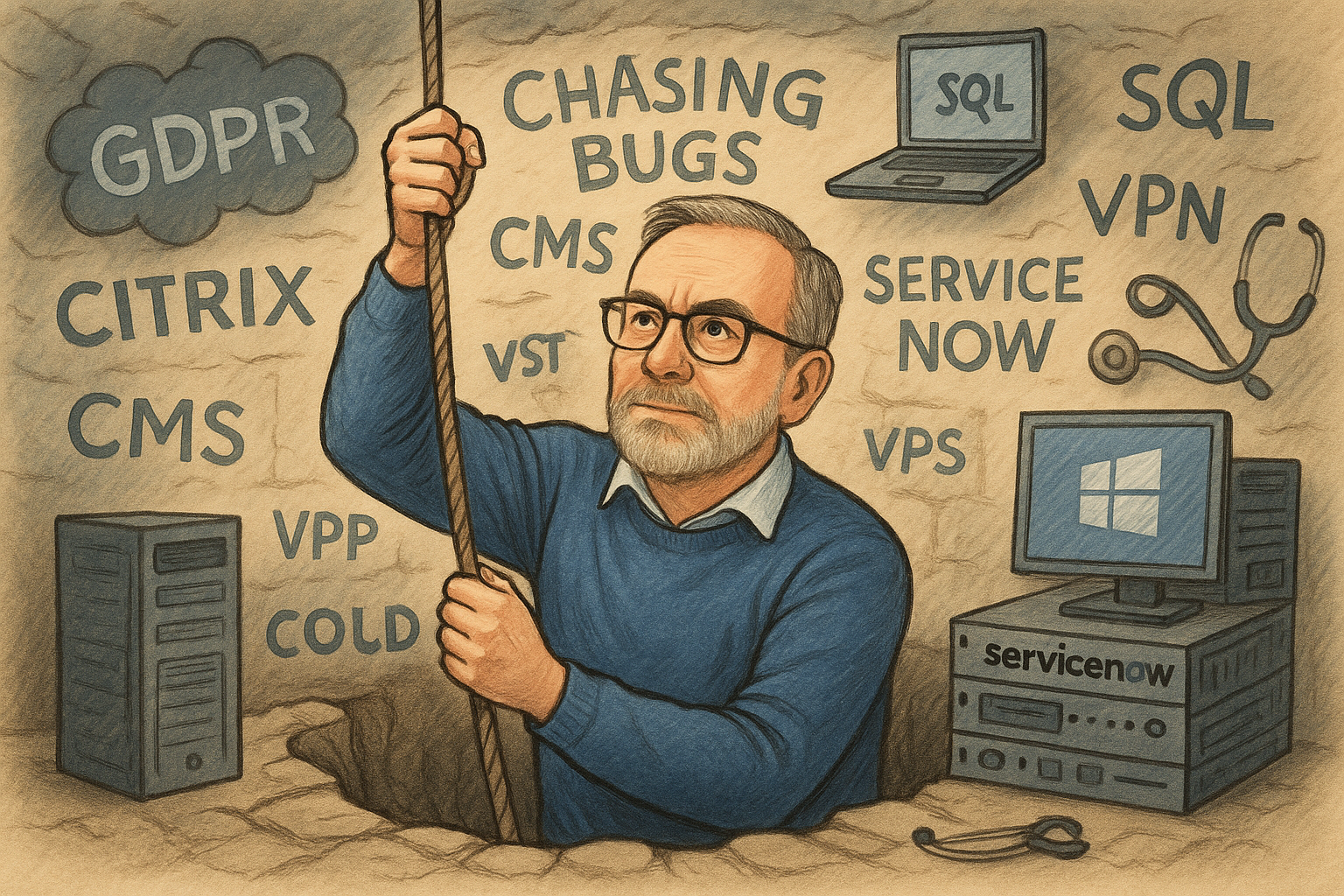
<p>Maybe the rope and the well in the image above is symbolic — or maybe I've just spent 30 years dragging systems, users, and occasionally myself back into daylight.</p>
<p>So here I am. Thirty years into IT. Sixty years into life. Still asking questions, still testing limits, still muttering at cables like they can hear me — and still convinced that turning it off and on again is the closest thing we've got to actual magic.</p>
            ]]>
        </content>
    </entry>
    <entry>
        <title>The Never-Ending IT-Support Firefight </title>
        <author>
            <name>Richard</name>
        </author>
        <link href="https://www.conram.it/the-never-ending-it-firefight.html"/>
        <id>https://www.conram.it/the-never-ending-it-firefight.html</id>
        <media:content url="https://www.conram.it/media/posts/14/itsupport-revolvingroom.png" medium="image" />
            <category term="servicedesk"/>
            <category term="security"/>
            <category term="project"/>
            <category term="itil"/>
            <category term="helpdesk"/>
            <category term="economics"/>
            <category term="documentation"/>
            <category term="cybersecurity"/>

        <updated>2025-02-19T11:27:09+01:00</updated>
            <summary type="html">
                <![CDATA[
                        <img src="https://www.conram.it/media/posts/14/itsupport-revolvingroom.png" alt="" />
                    Introduction Information technology support is essential for every modern business, yet it remains an underfunded, underappreciated, and high-turnover field. Despite its critical role in keeping systems running, support is often treated as an afterthought—staffed by new hires who rarely stay long enough to master the&hellip;
                ]]>
            </summary>
        <content type="html">
            <![CDATA[
                    <p><img src="https://www.conram.it/media/posts/14/itsupport-revolvingroom.png" class="type:primaryImage" alt="" /></p>
                <h2><strong>Introduction</strong></h2>
<p>Information technology support is essential for every modern business, yet it remains an underfunded, underappreciated, and high-turnover field. Despite its critical role in keeping systems running, support is often treated as an afterthought—staffed by new hires who rarely stay long enough to master the job, let alone improve it. This post explores three fundamental issues plaguing IT support: the relentless cycle of staff turnover, the loss of knowledge due to inadequate documentation, and the disconnect between support and technical specialists.</p>
<h2><strong>The Revolving Door – Where Good Technicians Go to Disappear</strong></h2>
<p>IT support functions like a well-oiled machine—not because it is efficient, but because people pass through it at alarming speed. New hires arrive, learn just enough to manage the most common issues, and then leave for better opportunities before they get too comfortable. The cycle repeats endlessly: recruit, train, overload with tickets, watch them leave, then start over.</p>
<p>The root cause is simple: cost. Businesses are reluctant to invest heavily in support, treating it as a necessary but expendable function. Salaries for first-line support are low <a href="#ref1" class="footnote">[1]</a>, and career prospects within the role are limited, leading to most employees treating it as a stepping stone rather than a long-term career. As a result, the average employment tenure is often no more than a year or two <a href="#ref2" class="footnote">[2]</a>. Many use the role to finance their studies <a href="#ref3" class="footnote">[3]</a>, further increasing turnover rates.</p>
<p>By the time an employee gains real experience, they realise they can earn more elsewhere or move up to a specialist role. This leads to an IT support paradox: those who get good at the job rarely stay in it.</p>
<h2><strong>The Knowledge Black Hole – Why the Same Problems Get Solved Again and Again</strong></h2>
<p>With employees cycling through support faster than documentation is maintained, knowledge transfer is minimal at best. Most businesses assume documentation will be written naturally as part of the job, which is as realistic as expecting users to read error messages before submitting a support ticket.</p>
<p>Even when documentation exists, it is often incomplete, outdated, or too generic to be useful. Studies have shown that documentation defects are common in software and IT systems, ranging from incorrect procedures to missing information <a href="#ref4" class="footnote">[4]</a>. Institutional knowledge disappears when experienced staff leave, and without proper documentation, new employees are forced to learn through trial and error <a href="#ref5" class="footnote">[5]</a>.</p>
<p>Instead of structured documentation, most support teams rely on verbal instructions, scattered emails, and undocumented fixes known only to a few senior staff. These individuals become the sole custodians of critical knowledge—until they also leave, at which point the team must start from scratch.</p>
<h2><strong>The Great Disconnect – Why Specialists Never See the Full Picture</strong></h2>
<p>Support is meant to filter simple issues and escalate complex ones to system specialists. In practice, this process is flawed. Some issues that should be escalated never reach specialists because support staff do not recognise them as systemic problems. Instead, recurring issues are handled in isolation, with each technician resolving the symptoms rather than identifying the root cause.</p>
<p>There is also an element of hesitation when escalating. Support staff do not want to appear incompetent, so they attempt to solve issues beyond their expertise. This often results in workarounds rather than permanent solutions. By the time specialists do become involved, the issue has either escalated into a full outage or has been patched together with so many temporary fixes that identifying the original problem becomes nearly impossible.</p>
<p>When issues are escalated, specialists often dismiss them unless they are immediately reproducible. This creates a frustrating cycle where support reports an issue, only for specialists to claim they cannot act without further evidence. The result? Users are advised to "restart the system and see if it happens again."</p>
<h2><strong>Conclusion</strong></h2>
<p>IT support remains an essential yet deeply flawed function within most businesses. The high turnover rate ensures that knowledge is constantly lost, poor documentation exacerbates the problem, and the disconnect between support and specialists prevents long-term solutions. Businesses that fail to address these structural problems will continue to face inefficiencies, frustrated employees, and recurring technical issues.</p>
<p>Until companies prioritise knowledge retention, invest in sustainable documentation, and foster better communication between support and specialists, IT support will remain trapped in a cycle of firefighting rather than progress.</p>
<h3 id="references"><strong>References</strong></h3>
<p><em>Some sources you can check, there are many more...</em></p>
<ol class="references">
<li id="ref1"><a href="https://techpays.com/europe/germany/eng_support/entry-level" target="_blank" rel="noopener noreferrer">TechPays</a> – Entry-level IT support salaries range between €30,000–€36,000 in most of Europe.</li>
<li id="ref2"><a href="https://www.centumsearch.com/employee-tenure-and-retention-for-tech-leaders-in-2024" target="_blank" rel="noopener noreferrer">Centum Search</a> – The average tenure in IT support is 1–2 years, often less in high-turnover environments.</li>
<li id="ref3"><a href="https://ec.europa.eu/eurostat/statistics-explained/index.php/ICT_specialists_in_employment" target="_blank" rel="noopener noreferrer">Eurostat</a> – A significant percentage of IT support roles are filled by students financing their studies or using the job as a stepping stone into better tech careers.</li>
<li id="ref4"><a href="https://arxiv.org/abs/2402.11048" target="_blank" rel="noopener noreferrer">arXiv</a> – Documentation is frequently outdated or inaccurate, leading to inefficiencies and repeated errors.</li>
<li id="ref5">Doakio (2023) – Poor documentation significantly slows down new hires and increases operational costs. (<a href="https://web.archive.org/web/20231116043846/https://doakio.com/blog/the-hidden-cost-of-poor-documentation-a-quantitative-study/" target="_blank" rel="noopener noreferrer">Archived at Internet Archive</a>)</li>
</ol>
<h3><strong>About This Post</strong></h3>
<p>This post is both an exploration of IT support's fundamental problems and a humorous reflection on the realities of working in first-line technical support. While written with a cynical tone, the issues discussed are based on real data and research. The goal is to shed light on the challenges faced by IT support teams and encourage organisations to take a more proactive approach to improving knowledge retention, documentation, and communication.</p>
            ]]>
        </content>
    </entry>
    <entry>
        <title>Publii - A system for my Site</title>
        <author>
            <name>Richard</name>
        </author>
        <link href="https://www.conram.it/publii-a-system-for-my-site.html"/>
        <id>https://www.conram.it/publii-a-system-for-my-site.html</id>
        <media:content url="https://www.conram.it/media/posts/6/publii.jpeg" medium="image" />
            <category term="web"/>
            <category term="project"/>
            <category term="internet"/>

        <updated>2025-01-31T12:39:57+01:00</updated>
            <summary type="html">
                <![CDATA[
                        <img src="https://www.conram.it/media/posts/6/publii.jpeg" alt="Publii" />
                    Switching code base - again... I’ve moved from manually coding HTML to using Publii, a desktop-based static site CMS. This change has made updates easier while keeping the site fast, secure, and fully in my control. ✅ No More Manual Coding – WYSIWYG editing with&hellip;
                ]]>
            </summary>
        <content type="html">
            <![CDATA[
                    <p><img src="https://www.conram.it/media/posts/6/publii.jpeg" class="type:primaryImage" alt="Publii" /></p>
                <h1>Switching code base - again...</h1>
<p>I’ve moved from manually coding HTML to using<strong> </strong><a rel="noopener" target="_new" href="https://getpublii.com/">Publii</a><strong>, </strong>a desktop-based static site CMS. This change has made updates easier while keeping the site fast, secure, and fully in my control.</p>
<h3><strong>Why Publii?</strong></h3>
<p>✅ No More Manual Coding – WYSIWYG editing with custom HTML when needed.<br>✅ Offline Editing &amp; One-Click Deployment – Work locally, publish when ready.<br>✅ Faster &amp; More Secure – No database, just lightweight static files.<br>✅ Customizable – Adjust design, tweak CSS, and integrate iframes easily.</p>
<h3><strong>What Changed?</strong></h3>
<ul>
<li><strong>Everything</strong>.</li>
<li>I need to add heaps of things for this to be kosher and correct.
<ul>
<li>Cookies</li>
<li>Stats</li>
<li>GDPR</li>
<li>Terms</li>
<li>etc... all that coming up shortly....</li>
</ul>
</li>
</ul>
<h3>Final Thoughts</h3>
<p>Publii lets me spend less time coding and more time on content. Having said that, content has not ever been a problem, quite the opposite, updates are few and far between. Perhaps that will change.</p>
<p>Try <a rel="noopener" target="_new" href="https://getpublii.com/">Publii</a>.</p>
            ]]>
        </content>
    </entry>
    <entry>
        <title>The Road to DDR5</title>
        <author>
            <name>Richard</name>
        </author>
        <link href="https://www.conram.it/the-road-to-ddr5.html"/>
        <id>https://www.conram.it/the-road-to-ddr5.html</id>
        <media:content url="https://www.conram.it/media/posts/5/maxresdefault.png" medium="image" />
            <category term="samsung"/>
            <category term="ryzen"/>
            <category term="project"/>
            <category term="pc"/>
            <category term="lian-li"/>
            <category term="hardware"/>
            <category term="gigabyte"/>
            <category term="g.skill"/>
            <category term="amd"/>

        <updated>2025-01-26T11:14:00+01:00</updated>
            <summary type="html">
                <![CDATA[
                        <img src="https://www.conram.it/media/posts/5/maxresdefault.png" alt="O11 Dynamic" />
                    Introduction: I don't need a new desktop. But just like turkey on Thanksgiving, DDR5 has forced its way in—inevitable, unavoidable. It's been a mentally taxing situation, but I decided to take it slow, spread the purchases over time, and carefully build an upgraded rig. This&hellip;
                ]]>
            </summary>
        <content type="html">
            <![CDATA[
                    <p><img src="https://www.conram.it/media/posts/5/maxresdefault.png" class="type:primaryImage" alt="O11 Dynamic" /></p>
                <div class="post__toc">
<h3>Table of Contents</h3>
<ul>
<li><a href="#mcetoc_1iitt6asmke">Introduction:</a></li>
<li><a href="#mcetoc_1iitt6asmkf">Setting Up a Plan</a>
<ul>
<li><a href="#mcetoc_1iitt6asmkg">Key Requirements:</a></li>
</ul>
</li>
<li><a href="#mcetoc_1iitt6asmkh">Choosing the Components</a>
<ul>
<li><a href="#mcetoc_1iitt6asmki">CPU: AMD Ryzen 5 7600X</a></li>
<li><a href="#mcetoc_1iitt6asmkj">Motherboard: Gigabyte X870E AORUS Elite WiFi 7</a></li>
<li><a href="#mcetoc_1iitt6asmkk">RAM: G.Skill Trident Z5 64GB DDR5-6000</a></li>
<li><a href="#mcetoc_1iitt6asmkl">Storage: Samsung 990 Pro (Heatsink Version)</a></li>
<li><a href="#mcetoc_1iitt6asmkm">Case: Lian Li O11 Dynamic Razer Edition</a></li>
<li><a href="#mcetoc_1iitt6asmkn">Cooling: Lian Li Galahad II Trinity SL-INF</a></li>
<li><a href="#mcetoc_1ijb9ujpk10">Not replaced</a></li>
</ul>
</li>
<li><a href="#mcetoc_1iitt6asmko">Addressing Compatibility &amp; RGB Control</a></li>
<li><a href="#mcetoc_1iitt6asmkp">The Build!</a>
<ul>
<li><a href="#mcetoc_1iitt6asmkq">Dual Chamber Build</a>
<ul>
<li><a href="#mcetoc_1ikcelvat8l">Case Width Matters More Than Expected</a></li>
<li><a href="#mcetoc_1ikcelvat8m">PSU Reuse &amp; Modular Cabling Woes</a></li>
<li><a href="#mcetoc_1ikcelvat8n">Fan &amp; USB Header Management</a></li>
<li><a href="#mcetoc_1ikcelvat8o">Front Panel Minimalism – No Reset, No LEDs</a></li>
</ul>
</li>
<li><a href="#mcetoc_1ikcelvat8p">Word of Warning</a></li>
</ul>
</li>
</ul>
</div>
<h2 id="mcetoc_1iitt6asmke"><strong>Introduction:</strong></h2>
<p>I don't <em>need</em> a new desktop. But just like turkey on Thanksgiving, DDR5 has forced its way in—inevitable, unavoidable. It's been a mentally taxing situation, but I decided to take it slow, spread the purchases over time, and carefully build an upgraded rig.</p>
<p>This article documents my transition to the AM5 platform, from initial thoughts to finalized hardware.</p>
<h2 id="mcetoc_1iitt6asmkf">Setting Up a Plan</h2>
<p>The goal was simple: a stable and future-proof system. I didn't want to jump on the absolute latest tech (such as the recently launched X890E chipset), but I still wanted a rig that would hold up for years. That's why I chose the X870E chipset, with DDR5 and PCIe 5.0 for long-term flexibility.</p>
<h3 id="mcetoc_1iitt6asmkg">Key Requirements:</h3>
<ul>
<li>ATX motherboard (to ensure at least three M.2 slots)</li>
<li>64GB DDR5 RAM</li>
<li>No SATA storage, only M.2 drives</li>
<li>Good airflow, skipping unnecessary HDD bays</li>
</ul>
<h2 id="mcetoc_1iitt6asmkh">Choosing the Components</h2>
<p>After watching and reading quite a few items available on the web - youtubes from GamersNexus and JaysTwoCents among others - adding to that some forum and Discord conversations, I ended up with the following setup:</p>
<h3 id="mcetoc_1iitt6asmki"><strong>CPU: AMD Ryzen 5 7600X</strong></h3>
<p>I originally considered the Ryzen 9 7900X, but ultimately decided to cut costs slightly without sacrificing much performance. The 7600X still offers excellent speeds and efficiency. I will benefit more from a more all round performance since my games do not require that much.</p>
<p><a href="https://www.amd.com/en/products/processors/desktops/ryzen/7000-series/amd-ryzen-5-7600x.html" target="_blank" rel="noopener noreferrer">Link</a></p>
<h3 id="mcetoc_1iitt6asmkj"><strong>Motherboard: Gigabyte X870E AORUS Elite WiFi 7</strong></h3>
<p>I debated between Asus, MSI, and Gigabyte for a while. Asus had some BIOS controversies, and MSI's Click BIOS interface received harsh criticism, so I landed on Gigabyte X870E—a well-balanced board with great PCIe and M.2 expansion options. I am not new to Gigabyte as brand, but I do think it may have been 8-9 years since my last hardware from them.</p>
<p><a href="https://www.gigabyte.com/Motherboard/X870E-AORUS-ELITE-WIFI7-rev-10-11#kf" target="_blank" rel="noopener noreferrer">Link</a></p>
<h3 id="mcetoc_1iitt6asmkk"><strong>RAM: G.Skill Trident Z5 64GB DDR5-6000</strong></h3>
<p>I checked compatibility against the motherboard's QVL list before purchasing. This kit only comes with XMP profiles, but my motherboard should handle it without issue.</p>
<p><a href="https://www.gskill.com/product/165/374/1649234977/F5-6000J3040G32GX2-TZ5RK-F5-6000J3040G32GA2-TZ5RK" target="_blank" rel="noopener noreferrer">Link</a></p>
<h3 id="mcetoc_1iitt6asmkl"><strong>Storage: Samsung 990 Pro (Heatsink Version)</strong></h3>
<p>I went with two Samsung 990 Pro PCIe 4.0 NVMe drives, one of which I already had. However, I ran into a common issue: my motherboard also includes built-in M.2 heatsinks, leading to a conflict. Since removing the Samsung heatsinks voids the warranty, I had to make a choice.</p>
<p>The Samsung heatsinks would not fit attached to the drives in the M.2 space of the Motherboard. I decided to keep them drives thus removing the heatsinks. Probably not recommended, warranty voided.</p>
<p><a href="https://www.samsung.com/se/memory-storage/nvme-ssd/nvme-pcie-gen-4-4tb-mz-v9p4t0gw/" target="_blank" rel="noopener noreferrer">Link</a></p>
<h3 id="mcetoc_1iitt6asmkm"><strong>Case: Lian Li O11 Dynamic Razer Edition</strong></h3>
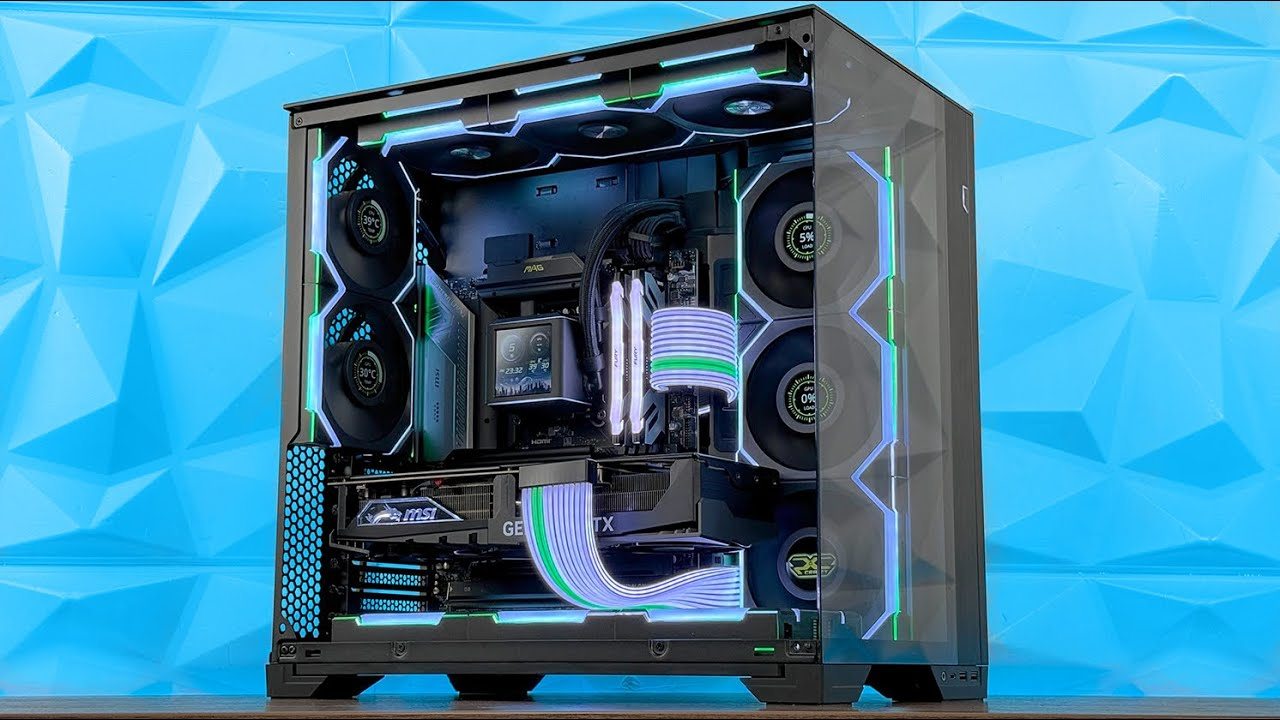
<p>After much deliberation (and countless YouTube reviews), I landed on this sleek RGB-friendly case. It fits ATX motherboards, has plenty of space for airflow, and pairs well with my Razer keyboard and mouse (which I got as a Christmas gift).</p>
<p><a href="https://lian-li.com/product/pc-o11-dynamic-razer-edition/" target="_blank" rel="noopener noreferrer">Link</a></p>
<h3 id="mcetoc_1iitt6asmkn"><strong>Cooling: Lian Li Galahad II Trinity SL-INF</strong></h3>
<p>Originally, I planned to use my Noctua NH-D15, but after realizing that my case only supports 155mm air coolers, I had to pivot to AIO liquid cooling. Lian Li's Galahad II matched both my budget and aesthetic.</p>
<p><a href="https://lian-li.com/product/galahad-ii-trinity/" target="_blank" rel="noopener noreferrer">Link</a></p>
<p>Additionally, I grabbed a set of Lian Li UNI Fans TL to improve airflow and keep things looking clean.</p>
<p><a href="https://lian-li.com/product/uni-fan-tl/" target="_blank" rel="noopener noreferrer">Link</a></p>
<h3 id="mcetoc_1ijb9ujpk10">Not replaced</h3>
<p>I should mention that I do not replace my Corsair RM850 PSU nor my Radeon RX6750XT GPU.</p>
<h2 id="mcetoc_1iitt6asmko"><strong>Addressing Compatibility &amp; RGB Control</strong></h2>
<p>A major concern was RGB software conflicts between:</p>
<ul>
<li>Gigabyte's RGB Fusion (for the motherboard)</li>
<li>Lian Li's L-Connect 3 (for the case &amp; fans)</li>
<li>Razer Synapse (for my keyboard/mouse)</li>
</ul>
<p>To simplify everything, I discovered <a href="https://signalrgb.com" target="_blank" rel="noopener noreferrer">SignalRGB</a>, a third-party tool that syncs many brands items into a single software controller. We will see what works.</p>
<h2 id="mcetoc_1iitt6asmkp"><strong>The Build!</strong></h2>
<p>With all parts in hand (or arriving within days), it's finally time to put everything together. The build will include:</p>
<ul>
<li>BIOS tuning</li>
<li>RAM latency optimizations</li>
<li>RGB synchronization</li>
<li>Cable management (or a valiant attempt at it)</li>
</ul>
<p>How smoothly will it go? Well… we'll see. Expect some loud cursing and misplaced screws. But once completed, this rig will be faster, cooler, and much quieter than my old AM4 system.</p>
<h3 id="mcetoc_1iitt6asmkq">Dual Chamber Build</h3>
<p>Unlike my previous builds, this case features a dual-chamber layout, which introduced a new dynamic to the building process. It turned out to be quite fiddly, constantly switching between the front and back, adjusting components in stages—push a bit, turn around, pull the rest. While the layout allows for a cleaner front view and better airflow, it also led to a few key realizations:</p>
<h4 id="mcetoc_1ikcelvat8l">Case Width Matters More Than Expected</h4>
<p>My Case selection (270mm wide) was not sufficient when it came to rear exhaust options and placing fans there. A slightly wider case would have allowed me to install a 120mm RGB exhaust fan in the upper-left CPU area, keeping it in line with the rest of my fans. In theory, two fans stacked vertically would have fit in a wider case—something to consider for future builds. As it stands, I left the space empty since the AIO's three top-mounted fans handle exhaust efficiently—so no real thermal concerns, so perhaps just an aesthetic limitation.</p>
<h4 id="mcetoc_1ikcelvat8m">PSU Reuse &amp; Modular Cabling Woes</h4>
<p>My Corsair RM850 PSU had enough wattage, so I opted to reuse it. However, I ran into a common issue when switching platforms:</p>
<ul>
<li>The CPU 12V 8-pin cables from my previous AM4 build were not compatible with the new AM5 motherboard's power requirements.</li>
<li>Modern PSUs often rearrange modular connectors, meaning even if the cables physically fit, the wiring layout can be different.</li>
<li>I also needed two CPU 8-pin connectors instead of one, a detail worth double-checking before reusing an older PSU.</li>
</ul>
<h4 id="mcetoc_1ikcelvat8n">Fan &amp; USB Header Management</h4>
<p>With nine fans total, daisy chaining helped, but I still needed two fan hubs for proper power and control. The motherboard only had two USB headers, which wasn't enough after factoring in the AIO and other devices.</p>
<p>The solution? A USB header expansion hub, along with ensuring a SATA power cable with at least three connectors was available for everything.</p>
<h4 id="mcetoc_1ikcelvat8o">Front Panel Minimalism – No Reset, No LEDs</h4>
<p>One thing I quickly noticed—this case completely lacks traditional front panel headers beyond the power button. There's no reset button, no HDD LED, and even no power LED. The only available connections are USB 3.0, USB 3.2, and the power button.</p>
<p>This isn't necessarily a dealbreaker, but if you rely on a reset button for quick reboots or like having HDD activity and power LED indicators, they're simply not there. If these features matter to you, consider a case that includes them—or be prepared to remap your motherboard's reset switch to another function (such as RGB control or an external power button mod).</p>
<h3 id="mcetoc_1ikcelvat8p">Word of Warning</h3>
<ul>
<li><strong>Dual-chamber cases may require extra patience.</strong> Space is not really tight, however expect constant repositioning to reach hidden connectors and routes.</li>
<li><strong>Check PSU modular cable compatibility.</strong> Even if the brand is the same, <strong>do not assume old cables work with a new platform.</strong></li>
<li><strong>Plan USB headers in advance.</strong> Many AIOs, fan hubs, and accessories eat up motherboard headers—make sure you have enough or grab an expansion hub.</li>
<li><strong>Wider cases give better flexibility.</strong> If you plan on using rear exhaust fans, make sure your case isn't too narrow to fit the same model and type of fans you've selected for the rest of your build. In my case, I couldn't use matching RGB fans in the rear due to space limitations and am still pondering whether to place some obscure 80mm fans there or not...</li>
</ul>
            ]]>
        </content>
    </entry>
    <entry>
        <title>Gaming - AC:Valhalla</title>
        <author>
            <name>Richard</name>
        </author>
        <link href="https://www.conram.it/gaming-acvalhalla.html"/>
        <id>https://www.conram.it/gaming-acvalhalla.html</id>
        <media:content url="https://www.conram.it/media/posts/4/ac-valhalla.png" medium="image" />
            <category term="windows"/>
            <category term="rpg"/>
            <category term="pc"/>
            <category term="game"/>

        <updated>2024-12-29T08:32:00+01:00</updated>
            <summary type="html">
                <![CDATA[
                        <img src="https://www.conram.it/media/posts/4/ac-valhalla.png" alt="AC: Valhalla" />
                    Assassin’s Creed: Valhalla ... is a game I spent a good amount of time with, almost 250 hours, exploring its vast world, engaging in its Viking-era storytelling, and diving into the mechanics that set it apart from previous AC titles. ✔ Exploration &amp; World Design&hellip;
                ]]>
            </summary>
        <content type="html">
            <![CDATA[
                    <p><img src="https://www.conram.it/media/posts/4/ac-valhalla.png" class="type:primaryImage" alt="AC: Valhalla" /></p>
                <h3><strong>Assassin’s Creed: Valhalla</strong></h3>
<p><em>...</em> is a game I spent a good amount of time with, almost 250 hours, exploring its vast world, engaging in its Viking-era storytelling, and diving into the mechanics that set it apart from previous AC titles.</p>
<figure class="post__image post__image--center"><img loading="lazy"  src="https://www.conram.it/media/posts/4/ac-full-width_ancaster_desktop.png" alt="AC:Valhalla by Ubisoft" width="1360" height="600" sizes="(max-width: 48em) 100vw, 768px" srcset="https://www.conram.it/media/posts/4/responsive/ac-full-width_ancaster_desktop-xs.webp 300w ,https://www.conram.it/media/posts/4/responsive/ac-full-width_ancaster_desktop-sm.webp 480w ,https://www.conram.it/media/posts/4/responsive/ac-full-width_ancaster_desktop-md.webp 768w ,https://www.conram.it/media/posts/4/responsive/ac-full-width_ancaster_desktop-lg.webp 1024w ,https://www.conram.it/media/posts/4/responsive/ac-full-width_ancaster_desktop-xl.webp 1360w ,https://www.conram.it/media/posts/4/responsive/ac-full-width_ancaster_desktop-2xl.webp 1600w"></figure>
<h3><strong>What Stood Out</strong></h3>
<p>✔ <strong>Exploration &amp; World Design</strong> – England’s open world feels immersive, with stunning landscapes and historical depth. Norway is larger that in game, could have been so much more. <br>✔ <strong>Raiding &amp; Settlement Building</strong> – A fresh addition to the AC formula, making progression more engaging.<br>✔ <strong>Combat &amp; Gear System</strong> – More weighty and brutal compared to earlier titles, fitting the Viking theme.<br>✔ <strong>Mythology &amp; Storytelling</strong> – The mix of Norse mythology and historical events added depth.</p>
<h3><strong>What Didn’t Work for Me</strong></h3>
<p>❌ <strong>Repetitive Activities</strong> – Raiding was fun but became boring over time.<br>❌ <strong>RPG Mechanics Felt Unbalanced</strong> – The skill tree and gear system sometimes felt more like padding than meaningful progression.<br>❌ <strong>The AC Identity</strong> – While a great Viking game, it didn’t always feel like an <em>Assassin’s Creed</em> title.<br>❌ <strong>Game progression</strong> - It grinded to a halt after 90% done and no solution for it. Will I restart it?</p>
<h3><strong>Final Thoughts</strong></h3>
<p>While <em>AC: Valhalla</em> delivered a solid Viking experience, it had some pacing and RPG elements that didn’t always land. Still, it was enjoyable for what it was—a sprawling, historical adventure rather than a classic AC stealth game.</p>
<p><a href="https://www.ubisoft.com/en-us/game/assassins-creed/valhalla" target="_blank" rel="noopener noreferrer">Assassin’s Creed Valhalla Official Site</a></p>
            ]]>
        </content>
    </entry>
</feed>